Understanding Shortage Allowances
read more

IMO has introduced significant changes to the International Grain Code, effective 1 January 2026, which will apply to all vessels carrying grains
In May 2024, the IMO Maritime Safety Committee (MSC) adopted relevant amendments to the International Code for the Safe Carriage of Grain in Bulk (Grain Code) via Resolution MSC.552(108). Adopted in 1991 and mandatory under SOLAS Chapter VI since 1994, the Grain Code applies to ships transporting bulk grains, such as wheat, maize (corn), and rice, as well as other commodities resembling grains, including soya beans and pulses. This amendment introduces a new optional loading condition that, while common in practice, was previously unaddressed by the IMO.
Shipowners and operators planning to utilise the new loading condition must revise their Grain Loading Manual and computer systems to incorporate this option, securing approval from the flag state administration or classification society before the regulation takes effect on 1 January 2026.
Historically, the Grain Code outlined three loading conditions for grain cargoes: ‘filled and trimmed’ (F-T), ‘filled and untrimmed’ (F-UT), and ‘partly filled compartments’ (PF) The amendments introduced by Resolution MSC.552(108) add a fourth loading pattern: ‘specially suitable compartment, partly filled in way of the hatch opening, with ends untrimmed’ (PF-UT). The new loading condition allows untrimmed grain surfaces under the cross deck, offering a feasible alternative to the traditional time-consuming, labour-intensive trimming methods often impractical for modern bulk carriers.
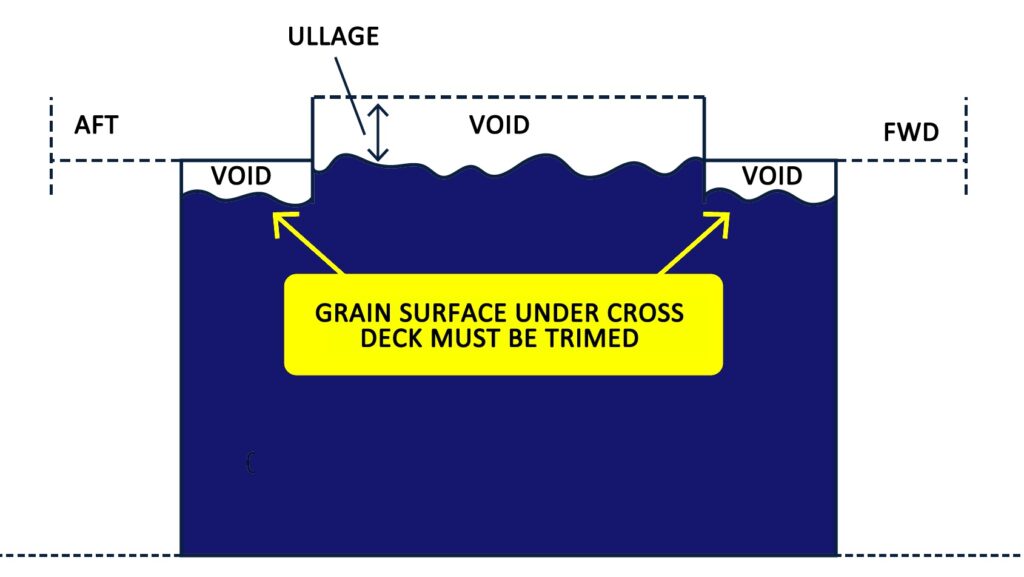
The PF-UT condition is defined as “…a specially suitable compartment which is not filled to the maximum extent possible in way of the hatch opening but is filled to a level equal with or above the bottom edge of the hatch end beams and has not been trimmed outside the periphery of the hatch opening by the provisions of A 10.4”. Under this method, the grain can be filled to a level equal to or above the bottom edge of the hatch end beams, but not necessarily to the maximum extent at the hatch opening. Under this pattern, the grain stowed at the ends remains untrimmed outside the periphery of the hatch opening, where it may rest at its natural angle of repose (typically assumed to be 30°), with only the free grain surface in way of the hatch opening requiring level trimming.
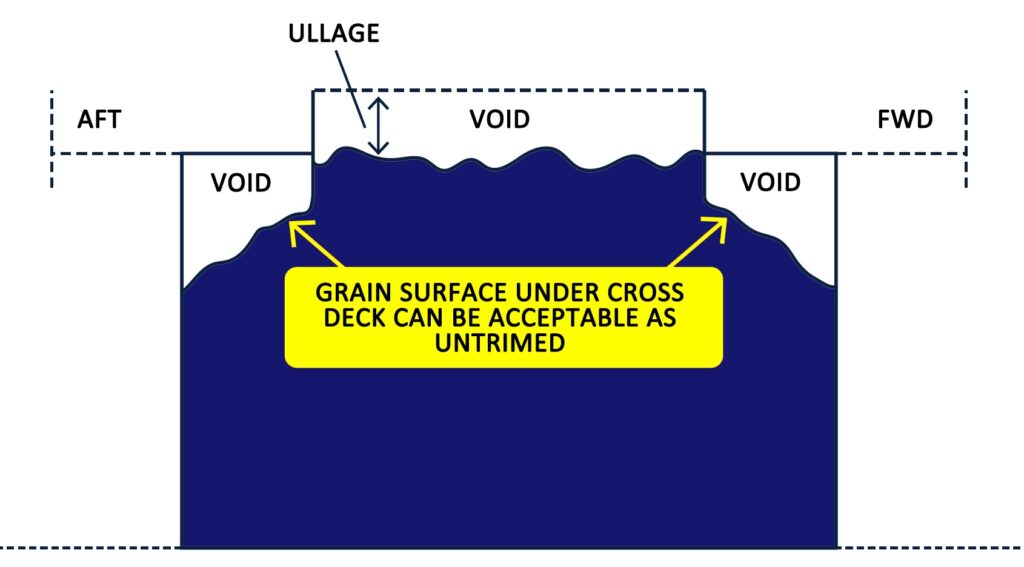
The new amendment enhances operational flexibility for ships carrying grain cargoes on international voyages, improving assessments of ship stability and exempting qualified compartments from trimming requirements, ultimately reducing cargo handling time and costs.
The primary risk associated with untrimmed grain is the potential for shifting, which can lead to severe heeling moments and compromise a vessel’s stability. To mitigate this, the amendments impose specific requirements:
Shipmasters and deck crews should undergo comprehensive training on the new loading condition, updated procedures, and recalibrated shipboard computer systems for an effective implementation of the latest requirements to ensure compliance and safe loading operations.
The amendments to the International Grain Code reflect a forward-thinking approach to balancing operational flexibility and cost-effectiveness without compromising safety standards. With the introduction of new regulations, Port State Control and relevant authorities will likely intensify scrutiny of vessels employing the newly permitted loading conditions to ensure compliance in both documentation and loading practices. Accurate record-keeping and adherence to regulations will be crucial for seamless operations, especially during the initial implementation phase.
Please read our disclaimer.
Related topics:
Rua Barão de Cotegipe, 443 - Sala 610 - 96200-290 - Rio Grande/RS - Brazil
Telephone +55 53 3233 1500
proinde.riogrande@proinde.com.br
Rua Itororó, 3 - 3rd floor
11010-071 - Santos, SP - Brazil
Telephone +55 13 4009 9550
proinde@proinde.com.br
Av. Rio Branco, 45 - sala 2402
20090-003 - Rio de Janeiro, RJ - Brazil
Telephone +55 21 2253 6145
proinde.rio@proinde.com.br
Rua Professor Elpidio Pimentel, 320 sala 401 - 29065-060 – Vitoria, ES – Brazil
Telephone: +55 27 3337 1178
proinde.vitoria@proinde.com.br
Rua Miguel Calmon, 19 - sala 702 - 40015-010 – Salvador, BA – Brazil
Telephone: +55 71 3242 3384
proinde.salvador@proinde.com.br
Av. Visconde de Jequitinhonha, 209 - sala 402 - 51021-190 - Recife, PE - Brazil
Telephone +55 81 3328 6414
proinde.recife@proinde.com.br
Rua Osvaldo Cruz, 01, Sala 1408
60125-150 – Fortaleza-CE – Brazil
Telephone +55 85 3099 4068
proinde.fortaleza@proinde.com.br
Tv. Joaquim Furtado, Quadra 314, Lote 01, Sala 206 - 68447-000 – Barcarena, PA – Brazil
Telephone +55 91 99393 4252
proinde.belem@proinde.com.br
Av. Dr. Theomario Pinto da Costa, 811 - sala 204 - 69050-055 - Manaus, AM - Brazil
Telephone +55 92 3307-0653
proinde.manaus@proinde.com.br
Rua dos Azulões, Sala 111 - Edifício Office Tower - 65075-060 - São Luis, MA - Brazil
Telephone +55 98 99101-2939
proinde.belem@proinde.com.br