
New Ballast Water Requirements at Bahia Ports
read more

Soya bean exports are gradually stabilising following a wave of phytosanitary violations that triggered facility suspensions and a ‘zero-tolerance’ policy, throwing port logistics into disarray at the height of the export season
Brazil remains the world’s foremost soya bean supplier, accounting for nearly 60% of global trade in the oilseed. It is the nation’s single largest export commodity by revenue – critical to sustaining a positive trade balance – and the most exported seaborne commodity by gross weight, second only to iron ore.
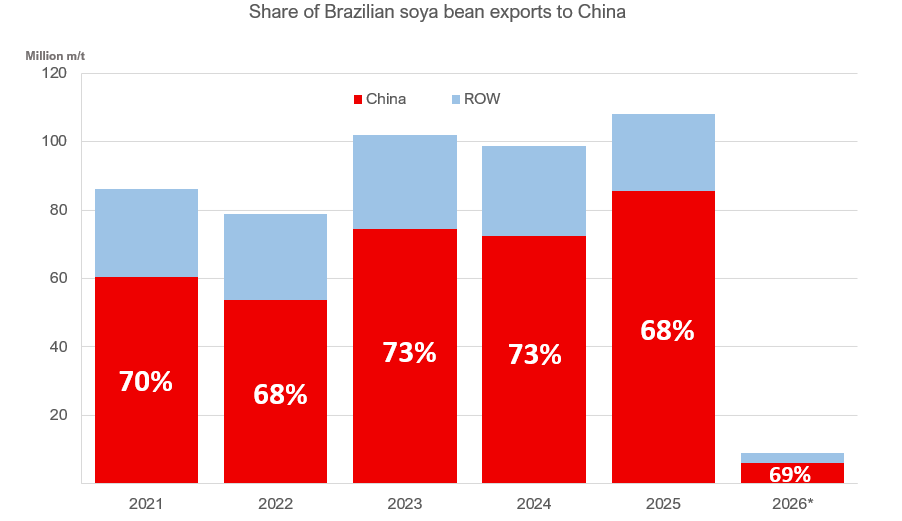
The Brazil—China soya bean corridor is a cornerstone of the Brazilian economy, with China firmly entrenched as an indispensable trading partner. In 2025, Brazil exported a record 108 million tonnes (Mmt) of the oilseed, a striking 85.1 Mmt (68%) of which was bound for Chinese ports alone.
Despite record exports in the previous cycle, the General Administration of Customs of China (GACC) has progressively intensified the phytosanitary scrutiny of incoming Brazilian soya bean shipments, which it claims are arriving with high levels of foreign matter. The escalating GACC enforcement actions reached a peak at the end of last year, when shipments carrying phytosanitary violations were intercepted. These included ten tonnes of wheat treated with banned pesticides, deemed toxic and unfit for human or animal consumption. The breach was further compounded by the fact that Brazilian wheat is not currently authorised for export to China. These violations prompted the temporary suspension of the licences of five facilities operated by traders: Cargill (two units), Louis Dreyfus Company (LDC), CHS Agronegócio, and 3Tentos.
Beyond chemical residues, Chinese authorities also reported the presence of quarantine weed seeds and live insects. The GACC requested that the Brazilian government give high priority to the safety of agricultural products destined for the Chinese market, demanding strengthened controls, reinforced oversight, and stricter phytosanitary measures. Affected traders were required to conduct internal audits, implement corrective measures, and demonstrate effective sanitary control capacity – all under the oversight of Brazil’s Ministry of Agriculture, Livestock, and Supply (MAPA) – before GACC would assess their reinstatement.
The immediate operational impact was severe, with more than 20 bulk carriers stalled and weekly export volumes plummeting from approximately 6 Mmt to just 1.5 Mmt in the first two months of 2026 – a disruption of particular consequence at the peak of Brazil’s export season.
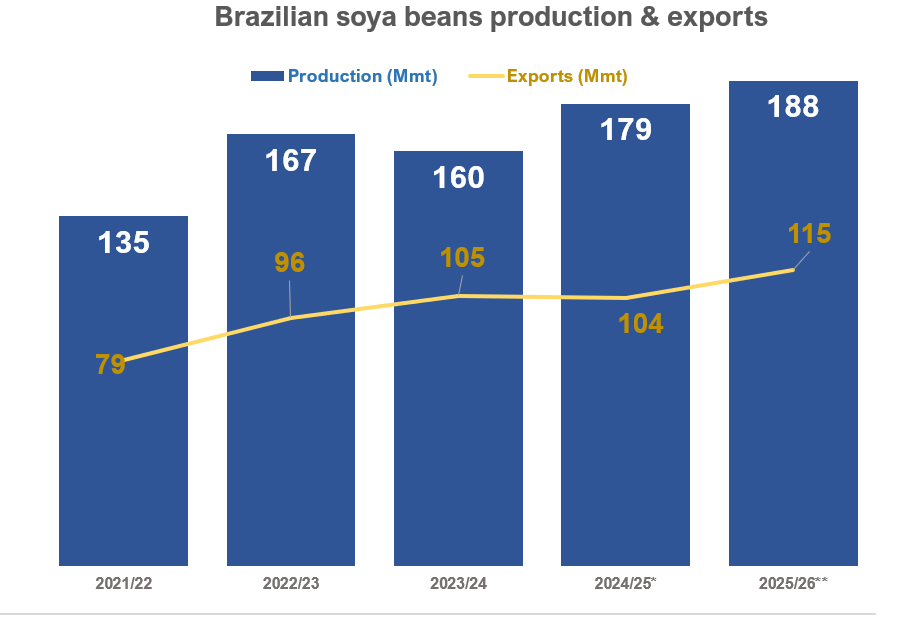
Both Brazil’s National Supply Company (CONAB) and the US Department of Agriculture (USDA) forecast that Brazil will set fresh production and export records in the 2025/26 marketing year. The USDA’s latest estimates project a harvest of approximately 180 Mmt – up around 5% from the previous season’s all-time high – with exports anticipated to reach some 114 Mmt, an increase of 11% over the 2024/25 cycle.
In response to GACC’s concerns, MAPA issued a revised directive on 13 March 2026, enforcing a stringent new sampling protocol. Circular Letter 7/2026/DIOPEX/CGVIGIAGRO/DTEC/SDA/MAPA outlines updated procedures for phytosanitary certification of soya bean shipments to China for immediate implementation. Key points include:
Following recent high-level discussions, Chinese authorities have acknowledged the technical impossibility of certifying the complete absence of weed seeds, given the inherent characteristics of large-scale oilseed production. The two countries have agreed on the following:
While Circular Letter 7/2026/DIOPEX/CGVIGIAGRO/DTEC/SDA/MAPA remains largely in force, MAPA revised the procedures on 20 March 2026 to reflect the easing of Chinese phytosanitary requirements. Key updates include:
Given the heightened scrutiny from Chinese customs authorities and MAPA’s revised inspection framework, carriers loading soya beans in Brazil are advised to take the following precautions:
These regulatory developments mark a meaningful step towards the normalisation of the significant Brazil-China soya bean trade flows. Nevertheless, the absence of a defined weed seed tolerance threshold indicates that the phytosanitary landscape remains unsettled.
We will continue to monitor GACC and MAPA directives closely and provide further updates as material developments emerge.
Please read our disclaimer.
Rua Itororó, 3 - 3rd floor
11010-071 - Santos, SP - Brazil
Telephone +55 13 4009 9550
proinde@proinde.com.br
Rua Barão de Cotegipe, 443 - Sala 610 - 96200-290 - Rio Grande/RS - Brazil
Telephone +55 53 3233 1500
proinde.riogrande@proinde.com.br
Av. Rio Branco, 45 - sala 2402
20090-003 - Rio de Janeiro, RJ - Brazil
Telephone +55 21 2253 6145
proinde.rio@proinde.com.br
Rua Professor Elpidio Pimentel, 320 sala 401 - 29065-060 – Vitoria, ES – Brazil
Telephone: +55 27 3337 1178
proinde.vitoria@proinde.com.br
Rua Miguel Calmon, 19 - sala 702 - 40015-010 – Salvador, BA – Brazil
Telephone: +55 71 3242 3384
proinde.salvador@proinde.com.br
Av. Visconde de Jequitinhonha, 209 - sala 402 - 51021-190 - Recife, PE - Brazil
Telephone +55 81 3328 6414
proinde.recife@proinde.com.br
Rua Osvaldo Cruz, 01, Sala 1408
60125-150 – Fortaleza-CE – Brazil
Telephone +55 85 3099 4068
proinde.fortaleza@proinde.com.br
Rua dos Azulões, Sala 111 - Edifício Office Tower - 65075-060 - São Luis, MA - Brazil
Telephone +55 98 99101-2939
proinde.belem@proinde.com.br
Tv. Joaquim Furtado, Quadra 314, Lote 01, Sala 206 - 68447-000 – Barcarena, PA – Brazil
Telephone +55 91 99393 4252
proinde.belem@proinde.com.br
Av. Dr. Theomario Pinto da Costa, 811 - sala 204 - 69050-055 - Manaus, AM - Brazil
Telephone +55 92 3307-0653
proinde.manaus@proinde.com.br