10th ABDM Congress on Maritime and Port Law
read more

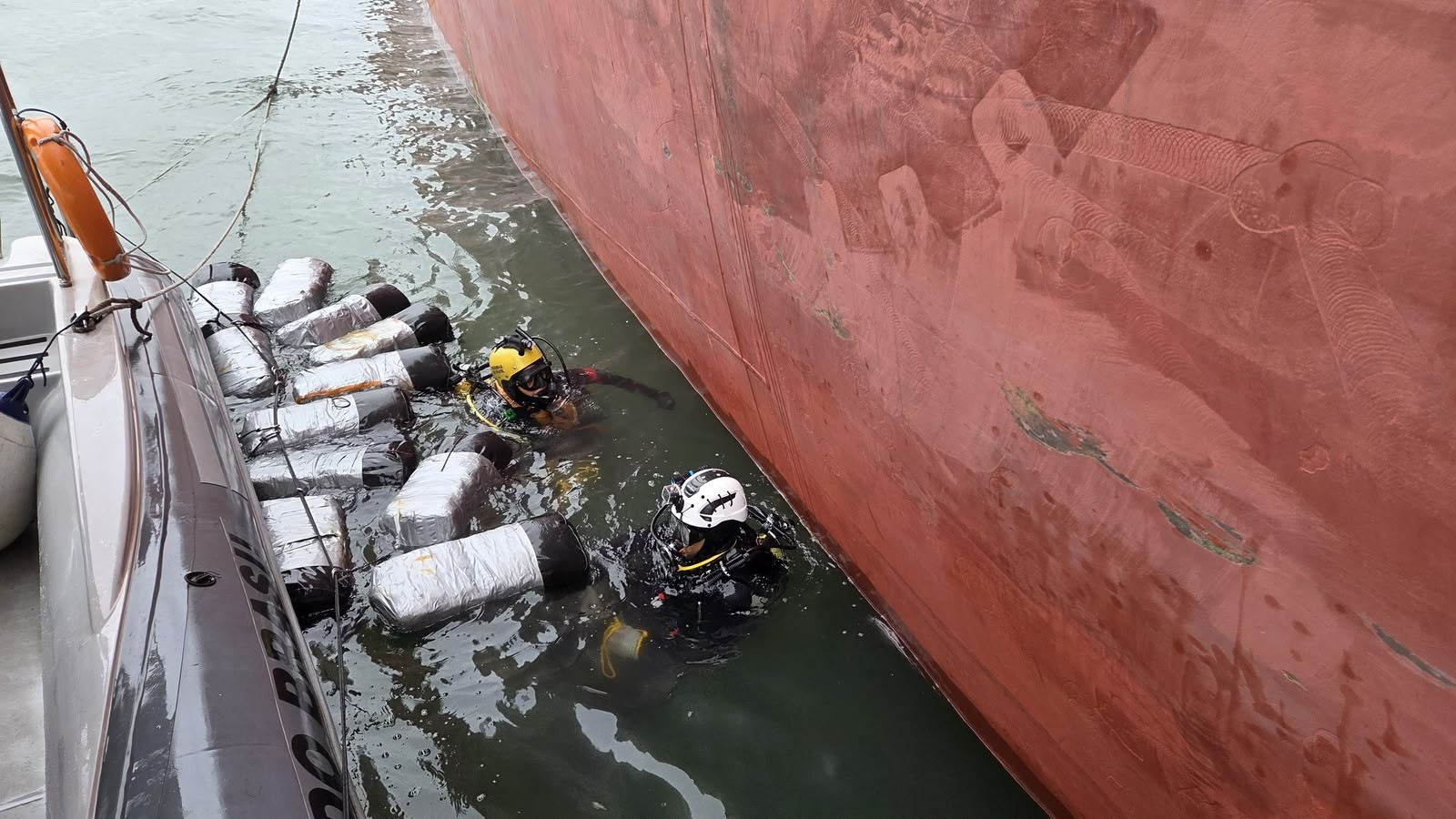
As container terminal security tightens, organised crime groups are increasingly turning to bulk carriers, concealing cocaine within cargo spaces and ship sea chests. Although the Federal Police have recently dismantled a specialised criminal network, maritime drug trafficking remains an ongoing threat at Brazilian ports
Maritime drug trafficking is a growing global security concern, and Brazil has emerged as a key transhipment hub for cocaine originating in the Andean region and destined for Europe, either directly or via African ports. This briefing examines the evolution of local smuggling tactics, key seizures, law enforcement responses, and legal implications. It also provides recommendations for shipowners and seafarers navigating Brazilian waters.
For years, the ‘rip-on/rip-off’ method –the practice of hiding narcotics within legitimate shipping containers– was the preferred choice for Brazilian cartels. However, a new trend in maritime drug smuggling has surfaced. Although the use of containers to transport drugs abroad remains widespread, following the pandemic, which saw intensified customs checks, high-definition scanning, and canine searches at container terminals, traffickers have exploited the lengthy stays of bulk carriers at anchorages and the typically low security of bulk terminals. They now conceal drugs not only on board but also in ship sea chests: underwater recesses built into hulls to draw seawater for engine cooling, ballast, and firefighting.
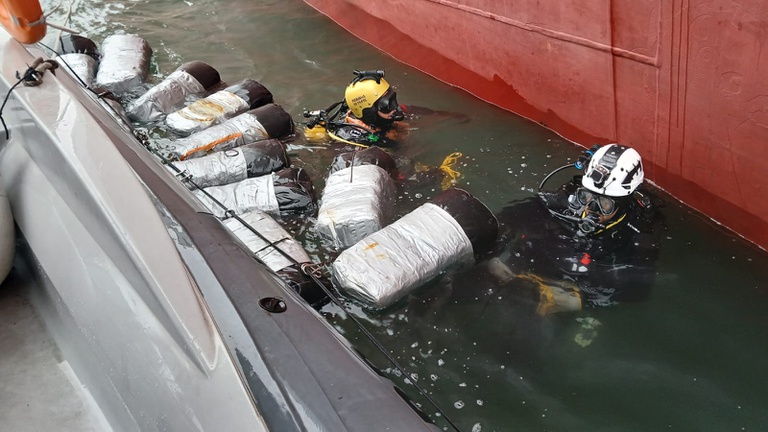
Whilst traffickers occasionally hide cocaine within bulk cargoes –such as sugar shipments from Brazil to West Africa– the most recurrent method is the concealment of narcotics inside sea chests. Underwater smuggling requires no crew complicity and presents a low risk of detection. Under the cover of darkness, highly skilled divers deploy from inconspicuous small craft or the shoreline. They unbolt the sea chest grates, insert ballasted, waterproof duffel bags packed with pure cocaine, and resecure the grates. The ship’s crew is often entirely unaware that their vessel has been contaminated with illicit drugs. At the destination port, or sometimes mid-voyage, local accomplice narco-divers – or even the same divers as at the origin – retrieve the packages while the vessel is anchored or berthed.
A recent high-profile seizure at the Port of Santos illustrates the ongoing prevalence of underwater smuggling. Earlier this month, a joint operation intercepted 342 kilogrammes of high-purity cocaine hydrochloride, neatly packed in waterproof bundles lodged inside the sea chest of a Liberian-flagged ship loading soya bean meal for Poland. Law enforcement was tipped off after the crew spotted a suspicious boat loitering alongside the bulk carrier. However, in most instances, drugs are only detected through pre-emptive underwater inspections arranged by proactive ship operators.
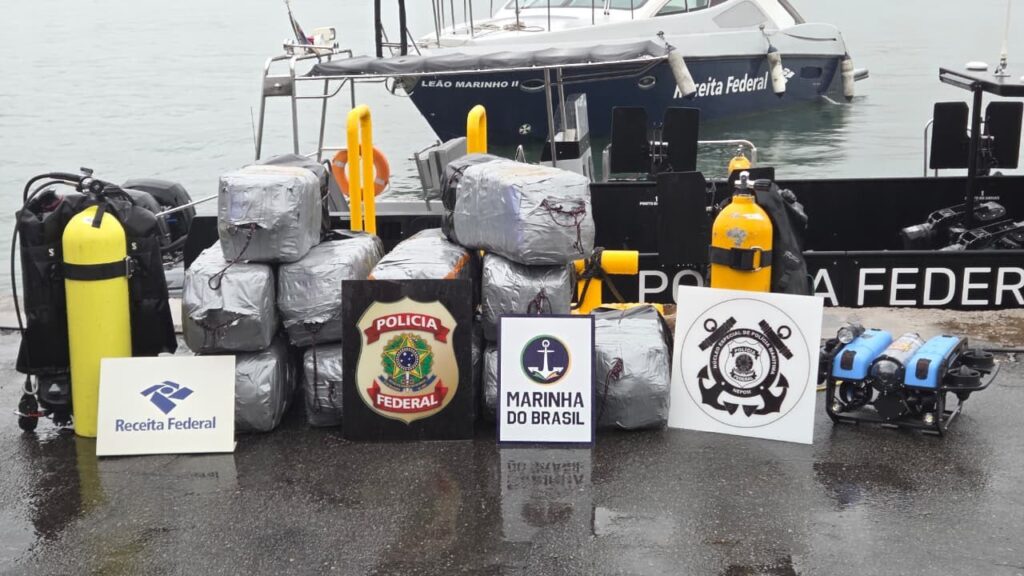
Police data show a steady increase in cocaine seizures at Brazilian ports and terminals over the past five years, with a marked shift towards underwater concealment. In 2026 alone, authorities intercepted several major shipments hidden in containers and below the ship’s waterline, underscoring the growing ingenuity and scale of maritime smuggling operations.
| Date | Port | Weight (Kg) | Hidden Location | Destination |
| 4 Feb | Santos | 240 | Canned soya bean oil in containers | Portugal |
| 24 Feb | Santos | 461 | Paper pallets in containers | UK |
| 10 Mar | Paranaguá | 226 | Hollowed pine timber in containers | Italy |
| 12 Mar | Santos | 214 | Cargo truck cab lining in a Ro-Ro ship | EU port |
| 24 Apr | Paranaguá | 22 | Inside a reefer condenser | Netherlands |
| 10 May | Santos | 342 | Ship hull sea chest | Poland |
| 25 May | Santos | 48 | Inside a reefer container | EU port |
Last week, a major operation by the Federal Police dismantled an international drug trafficking scheme operating through the southern ports of Itajaí, Navegantes, Imbituba, Itapoá, and São Francisco do Sul in Santa Catarina. Three professional divers were arrested for hiding cocaine in sea chests, alongside fifteen other individuals. The authorities executed dozens of search and seizure warrants across twelve cities in the states of Santa Catarina, Paraná, and Minas Gerais. The criminal group is accused of setting up shell companies and employing divers for underwater drug concealment. The police estimate that since 2023, when investigations began, approximately 4.6 tonnes of cocaine have been seized from ship sea chests and legitimate export goods.
The drug destination is almost always the lucrative European market, where cocaine consumption and availability have reached unprecedented levels, according to recent statistics by the European Union Drugs Agency (EUDA). Organised criminal groups carefully target ships to be used as drug ‘mules’ based on:
This is the most lucrative route for organised crime groups. Vessels departing Brazil cross the Atlantic and enter the English Channel, calling at major ports including Antwerp, Rotterdam, and Hamburg – key gateways for European drug distribution.
Ships bound for Southern and Eastern Europe that transit the Strait of Gibraltar frequently face underwater retrieval operations or covert offloading at well-chosen drop points in Spain, Italy, or Greece. These Mediterranean ports are prime targets for traffickers seeking quick entry into European markets.
To evade customs profiling and law enforcement scrutiny on the Brazil-Europe transit, syndicates frequently route shipments through West African nations such as Nigeria. By manipulating the cargo manifest’s history, they aim to circumvent risk profiling flags when the cargo ultimately arrives in Europe.
When sealed containers are moved under Full Container Load (FCL) terms – packed and sealed by the shipper – the carrier and crew are generally shielded from liability, provided the original seals remain intact. However, if narcotics are discovered within the ship’s own compartments (deck spaces, accommodation, or cargo holds), law enforcement often presumes crew collusion until proven otherwise.
Should authorities detect inconsistencies or suspect negligence, seafarers may face immediate arrest and prosecution, while the ship can be detained until the owners or their insurers provide security. In some jurisdictions, a conviction for maritime drug trafficking carries severe penalties, including lengthy prison sentences or even capital punishment.
Ship arrest or detention exposes owners to significant financial risks, including loss of hire, costly delays, crew maintenance expenses, breach of charterparty agreements, and serious reputational damage.
When drugs are found in underwater spaces (such as sea chests), the Federal Police in Brazil typically do not detain or formally question the crew, presuming they were not complicit in the trafficking operation. Ships are usually cleared to resume their voyages without significant operational delays. Police share their findings with destination port authorities and focus investigations on local actors.
For seizures concealed within breakbulk or containerised cargo, the Federal Police and the Federal Revenue Service (customs) launch inquiries involving auditing of the supply chains to identify at which point the logistics loop was breached – either by corrupt terminal staff, compromised truck drivers, or cloned container seals.
Because the destinations of seized shipments involve major international crime networks, the Federal Police coordinate directly with foreign entities such as Europol and Interpol, as well as national law enforcement agencies. Data collected from seized phones and matching chemical profiles of the narcotics are shared with authorities to dismantle reception cells at target destinations.
Authorities frequently suspect insider collusion whenever narcotics are found on or beneath a vessel, making it critical for the ship operator and crew to demonstrate robust due diligence. To protect themselves from legal and commercial fallout, shipowners and crews must treat drug prevention as a core operational priority – especially when calling at Brazilian ports. Best-practice security measures include:
The surge in maritime drug trafficking from Brazilian ports has fuelled a growing industry of shoreside anti-drug services. While contractors for CCTV surveillance, additional watchkeeping, and drug-detection dogs may help in some cases, these services are only recommended if a risk assessment identifies security gaps or local threats. Nevertheless, operators of ships departing for Africa or Europe should consider thorough pre-departure underwater inspections – using vetted divers or remotely operated vehicles (ROVs), where available – to conduct underwater sweeps and ensure no illicit packages are attached to the hull before departure from the last port of call in Brazil.
ROVs (underwater drones) are invaluable for tackling the hazardous, time-consuming work of inspecting ship hulls in often murky or high-current waters, or when limited under-keel clearance renders conventional diving unsafe. If grates show signs of tampering or anomalous objects are observed via live video stream, local authorities and approved divers must be deployed immediately for a thorough inspection.
Shipowners procuring underwater services in Brazil must ensure that any commercial diving contractor complies with the standards set by the Directorate of Ports and Coasts (DPC) under NORMAM-222/DPC (Maritime Authority Standards for Commercial Diving). This not only guarantees safety and legal compliance but also demonstrates due diligence in the event of a security incident.
For more detailed information, refer to our free publication Shipborne Drug Trafficking in Brazil – Practical Guidance, which offers detailed recommendations for shipowners and crews.
Please read our disclaimer.
Related topics:
Rua Itororó, 3 - 3rd floor
11010-071 - Santos, SP - Brazil
Telephone +55 13 4009 9550
proinde@proinde.com.br
Rua Barão de Cotegipe, 443 - Sala 610 - 96200-290 - Rio Grande/RS - Brazil
Telephone +55 53 3233 1500
proinde.riogrande@proinde.com.br
Av. Rio Branco, 45 - sala 2402
20090-003 - Rio de Janeiro, RJ - Brazil
Telephone +55 21 2253 6145
proinde.rio@proinde.com.br
Rua Professor Elpidio Pimentel, 320 sala 401 - 29065-060 – Vitoria, ES – Brazil
Telephone: +55 27 3337 1178
proinde.vitoria@proinde.com.br
Rua Miguel Calmon, 19 - sala 702 - 40015-010 – Salvador, BA – Brazil
Telephone: +55 71 3242 3384
proinde.salvador@proinde.com.br
Av. Visconde de Jequitinhonha, 209 - sala 402 - 51021-190 - Recife, PE - Brazil
Telephone +55 81 3328 6414
proinde.recife@proinde.com.br
Rua Osvaldo Cruz, 01, Sala 1408
60125-150 – Fortaleza-CE – Brazil
Telephone +55 85 3099 4068
proinde.fortaleza@proinde.com.br
Rua dos Azulões, Sala 111 - Edifício Office Tower - 65075-060 - São Luis, MA - Brazil
Telephone +55 98 99101-2939
proinde.belem@proinde.com.br
Tv. Joaquim Furtado, Quadra 314, Lote 01, Sala 206 - 68447-000 – Barcarena, PA – Brazil
Telephone +55 91 99393 4252
proinde.belem@proinde.com.br
Av. Dr. Theomario Pinto da Costa, 811 - sala 204 - 69050-055 - Manaus, AM - Brazil
Telephone +55 92 3307-0653
proinde.manaus@proinde.com.br