Northern Arc: Draft Increases and New Safety ...
read more

Proactive emergency measures and El Niño warnings signal severe operational disruptions for shipping at Brazil’s Northern Arc river ports
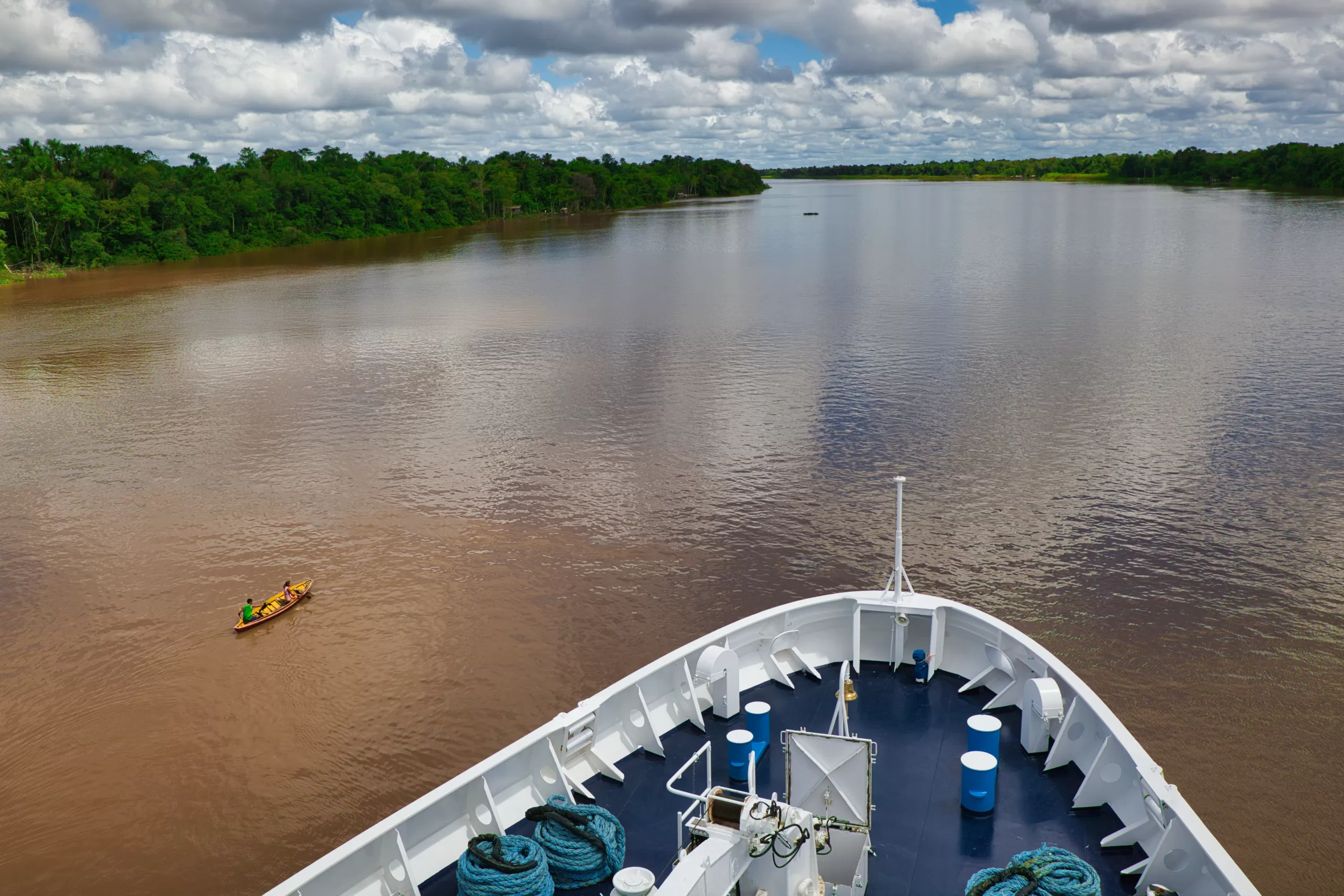
While the rest of Brazil experiences its lowest average temperatures between June and September, the Amazon basin undergoes its hottest and driest period, historically referred to locally as the “Amazon Summer”. Although seasonal droughts are a recurring natural feature and navigation restrictions are generally predictable, the rapid escalation and severity of this complex climate phenomenon have increased significantly.
Following the unprecedented water crises of recent years, the latest forecasts from state and federal monitoring bodies indicate that the upcoming dry season could match or even surpass previous historical extremes. The Northern Arc corridor has become a primary pillar of Brazilian trade, now handling over 53% of the nation’s soya bean and maize (corn) exports. Consequently, falling river levels are no longer considered isolated regional issues, but major risks to national agribusiness competitiveness.
Marking a significant shift from the reactive emergency responses of past crises, regional authorities are now taking early administrative action. The State Government of Amazonas has declared an environmental and climatic state of emergency across its municipalities. This legal mechanism enables local governments to streamline resource allocation, fast-track emergency dredging contracts, and coordinate early relief to vulnerable riverine communities before isolation occurs.
The Civil Defence of Amazonas, alongside the Centre for Management and Operational System of the Amazon Protection (CENSIPAM), confirmed that emergency response teams are already being deployed regionally to mitigate the severe environmental, social, and economic impacts expected in the second half of the year.
At the federal level, a specialised situation room coordinated by the Chief of Staff’s Office—with participation from multiple ministries and public agencies—has been established to anticipate logistics protection measures. However, the legal landscape has become politically sensitive following indigenous community mobilisations against a federal decree, which had initially approved privatised waterway exploration and led to the temporary occupation of the Cargill terminal in Santarém, on the Tapajós River. Demanding adequate consultation and environmental safeguards, these actions prompted the Federal Government to officially revoke the decree and suspend certain waterway agenda items. The current challenge lies in balancing social legitimacy with the objective requirement for predictable river level maintenance.
A recent Federal Court of Accounts (TCU) audit of federal waterway policy highlighted systemic weaknesses in data collection, planning, and governance, noting that a lack of long-term structural public policy directly increases the ‘Brazil Cost’ and forces cargo onto stressed road or rail systems when the Northern Arc loses capacity during strong crop cycles.
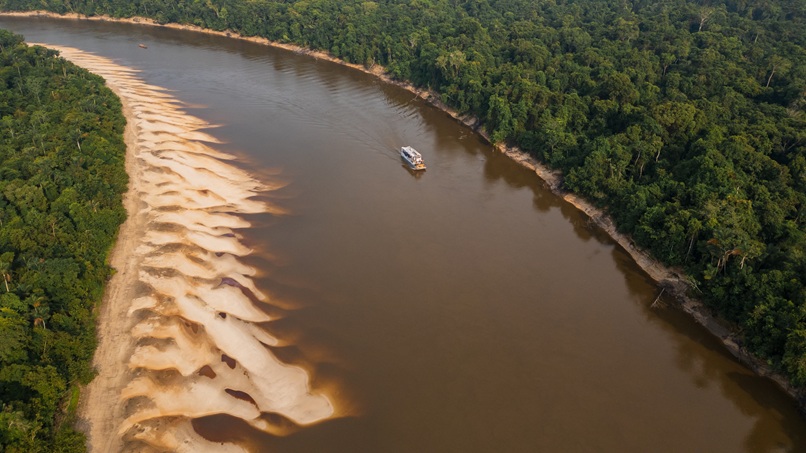
Meteorological bulletins from the National Institute for Space Research (INPE), the National Institute of Meteorology (INMET), and CENSIPAM attribute the severe prospects to a prolonged climate water deficit driven by a high probability of Super El Niño conditions developing in the second half of 2026, with compounding effects potentially stretching well into 2027. A residual “seesaw” climate pattern has created a drastic, volatile shift in the biome: although the year began with heavy rainfall and relatively high river levels, rising global temperatures and the lingering footprint of the El Niño phenomenon are causing rivers to drop significantly and violently.
Forecasters warn that the traditional four-month dry spell is extending into a five-to-six-month crisis, rapidly drying out regional vegetation and exponentially increasing the risk of widespread wildfires during its most critical stages.
The impending rapid drops in river levels pose an immediate threat to the major navigable arteries of the Northern Arc ports, specifically along the Amazon, Madeira, and Solimões rivers. During previous severe droughts, maritime and waterway authorities were forced to implement drastic operational restrictions, including:
Heightened draft and under-keel clearance (UKC) limitations, coupled with the eventual enforcement of Low Water Surcharges (LWS) by major container carriers, contribute to a reduction in carrying capacity and increased transit costs for shipowners and cargo owners. While regulatory bodies such as the National Waterway Transport Agency (ANTAQ) monitor LWS fees to prevent pricing abuse, carriers may reinstate them if the Rio Negro in Manaus drops below critical operational thresholds.
The Federation of Industries of the State of Amazonas (FAE) and local business networks have issued urgent advisories to industrial producers and merchants operating within the Manaus Free Trade Zone (ZFM). Businesses are strongly urged to pre-emptively stock up on raw components, fuel, water, and essential consumer goods while the waterways remain fully navigable, preventing severe supply chain bottlenecks ahead of the peak year-end retail season.
The National Department of Transport Infrastructure (DNIT) is mobilising for emergency dredging on the Amazon, Solimões, and Madeira rivers to mitigate severe drought impacts. The Association of Private Port Terminals (ATP) and the Brazilian Association of Cabotage Shipowners (ABAC) have strongly advocated for maintenance dredging campaigns to be completed by August, prior to the arrival of the severe low-water peaks in October.
DNIT confirmed that critical bathymetric survey campaigns commenced in mid-June and should be finalised in July to pinpoint the areas of greatest concern.
As river levels fluctuate daily during a severe dry season, conditions can deteriorate rapidly. Shipowners, operators, and masters intending to fix vessels or transit the Amazon basin during this period should consider the following precautionary measures:
As the 2026 dry season approaches, navigating the Amazon river system requires heightened structural foresight rather than reactive adjustments. Given the shifting regulatory framework, looming Super El Niño conditions, and the significant risk of draft reductions, ship operators and agents must maintain continuous communication with local maritime and port authorities. Real-time coordination and proactive contract management remain vital to sustaining operational integrity across the Northern Arc corridor during this volatile climatic cycle.
Please read our disclaimer
Related Topics:
Rua Itororó, 3 - 3rd floor
11010-071 - Santos, SP - Brazil
Telephone +55 13 4009 9550
proinde@proinde.com.br
Rua Barão de Cotegipe, 443 - Sala 610 - 96200-290 - Rio Grande/RS - Brazil
Telephone +55 53 3233 1500
proinde.riogrande@proinde.com.br
Av. Rio Branco, 45 - sala 2402
20090-003 - Rio de Janeiro, RJ - Brazil
Telephone +55 21 2253 6145
proinde.rio@proinde.com.br
Rua Professor Elpidio Pimentel, 320 sala 401 - 29065-060 – Vitoria, ES – Brazil
Telephone: +55 27 3337 1178
proinde.vitoria@proinde.com.br
Rua Miguel Calmon, 19 - sala 702 - 40015-010 – Salvador, BA – Brazil
Telephone: +55 71 3242 3384
proinde.salvador@proinde.com.br
Av. Visconde de Jequitinhonha, 209 - sala 402 - 51021-190 - Recife, PE - Brazil
Telephone +55 81 3328 6414
proinde.recife@proinde.com.br
Rua Osvaldo Cruz, 01, Sala 1408
60125-150 – Fortaleza-CE – Brazil
Telephone +55 85 3099 4068
proinde.fortaleza@proinde.com.br
Rua dos Azulões, Sala 111 - Edifício Office Tower - 65075-060 - São Luis, MA - Brazil
Telephone +55 98 99101-2939
proinde.belem@proinde.com.br
Tv. Joaquim Furtado, Quadra 314, Lote 01, Sala 206 - 68447-000 – Barcarena, PA – Brazil
Telephone +55 91 99393 4252
proinde.belem@proinde.com.br
Av. Dr. Theomario Pinto da Costa, 811 - sala 204 - 69050-055 - Manaus, AM - Brazil
Telephone +55 92 3307-0653
proinde.manaus@proinde.com.br