Agribusiness and Port Logistics Brace for El ...
read more

As Brazil concludes a record-shattering 2025/26 marketing season, recent estimates point to an even stronger throughput in the upcoming 2026/27 cycle
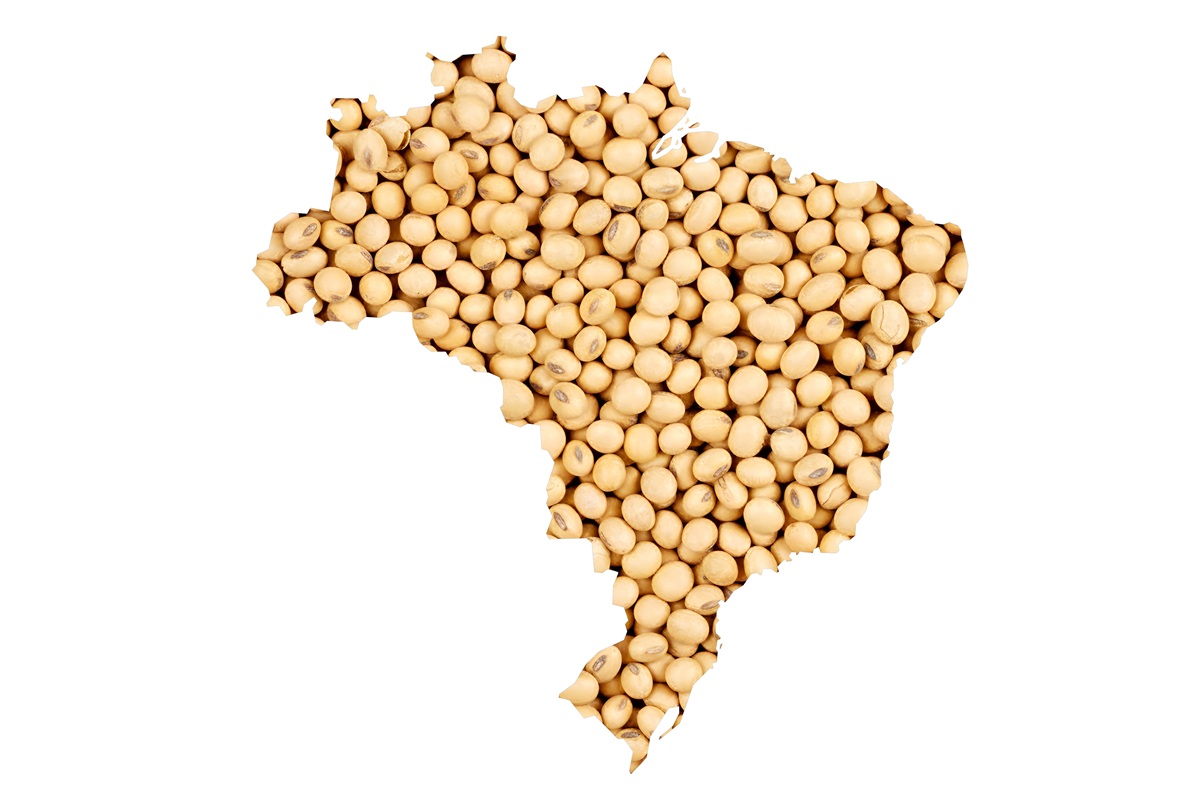
The Brazilian soya bean sector continues to achieve unprecedented growth, solidifying its position as the world’s leading producer and exporter of this versatile oilseed. This expansion is driven by strategic expansion in planted area, advances in agricultural technology, and strong international demand – anchored by a massive reliance on the Chinese market. As the 2025/26 marketing year concludes, Brazilian agribusiness is poised for new record volumes and gains in the forthcoming 2026/27 cycle. However, producers still face challenges, including elevated interest rates, rising input costs, and the effects of El Niño weather patterns.
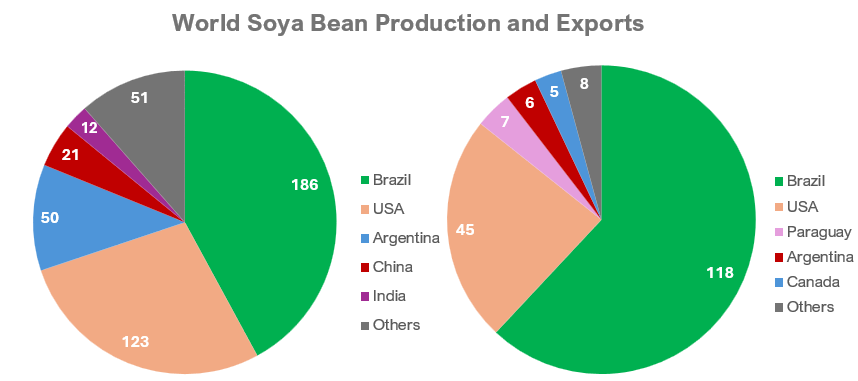
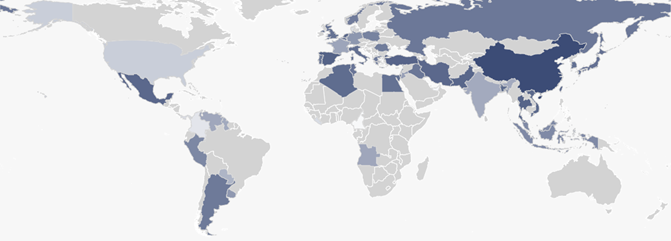
As Brazilian producers wrap up the 2025/26 season, both the National Supply Company (CONAB) and its counterpart, the United States Department of Agriculture (USDA), estimate Brazil’s soya bean production at a record 180.5 million metric tonnes (mmt). This marks a notable 5.3% growth year-on-year, keeping Brazil well ahead of its main competitors, the United States (116 mmt) and Argentina (49.5 mmt). Both agencies project total Brazilian soya bean sales for this season to reach an unprecedented 115 mmt, followed by the US (41.4 mmt), Argentina (9 mmt), and Paraguay (8.2 mmt). Figures 1 & 2
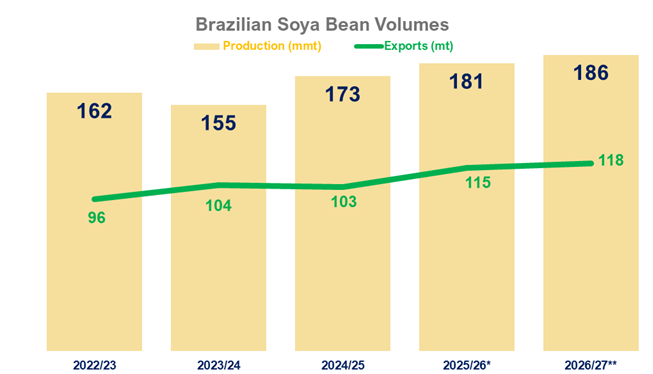
Data from the Ministry of Development, Industry, Trade and Services (MDIC) indicates that Brazilian soya bean sales from January to July 2026 reached 83 mmt, 7.5% higher than the same period last year, with FOB revenues amounting to US$ 35 billion (+15.3%), an average of US$ 400/tonne (+ 7.3%), ranking the oilseed the first item of Brazil’s export basket during this period. As usual, China was by far the main importer, buying 58 mmt of the commodity in the first semestre, covering 70% of the sales, followed by Spain (4.1%), Turkey (3.2%), Thailand (3%), and Pakistan (2.3%). Figure 3
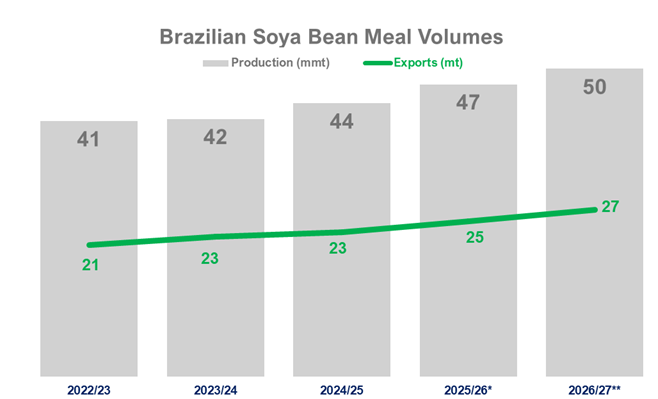
Brazil’s industrial soya bean crushing remains strong, sustained by steady global demand and consecutive record highs in output and trade volumes. According to USDA and CONAB data, the country’s soya bean meal (seedcake) processing is expanding steadily, rising from 41.5 mmt in the 2022/23 marketing year to a projected record of 50 mmt in the upcoming 2026/27 cycle. This growth is fuelled by domestic crush operations and scaling infrastructure to meet both internal feed needs and international demand. On the export side, favourable global market prospects have prompted federal agricultural agencies to revise Brazil’s soya bean meal shipping forecasts upwards for consecutive seasons. The outlook for 2025/26 has been increased to 25 mmt, while the projection for 2026/27 stands at an unprecedented 27 mmt. These updates highlight the country’s strengthening position in international protein meal trade, moving in step with rising worldwide commodity prices and increased purchases from key international markets. Figure 4
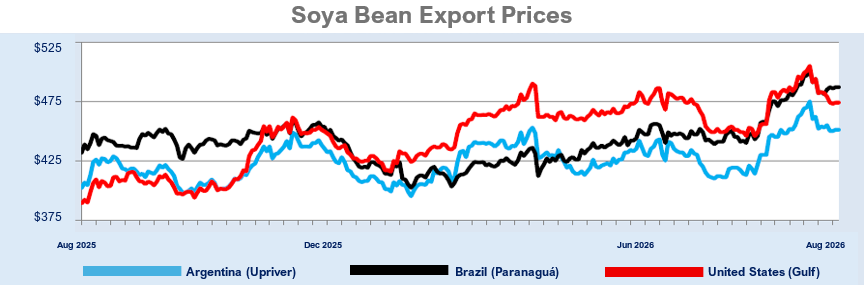
Looking ahead to the 2026/27 marketing year, the USDA’s early global forecasts suggest Brazil will surpass its previous records once again. The US agency estimates the soya bean harvest will reach 186 mmt, accounting for over 40% of total global output. Export volumes are expected to climb to 118 mmt, while domestic crushing facilities are forecast to process 65 mmt of soya beans, capitalising on high international margins. Soya bean export prices, which experienced minor fluctuations in mid-July due to global weather shifts, have stabilised and continue to track closely with global benchmarks, keeping Brazilian oilseed highly competitive at international ports. Figure 5
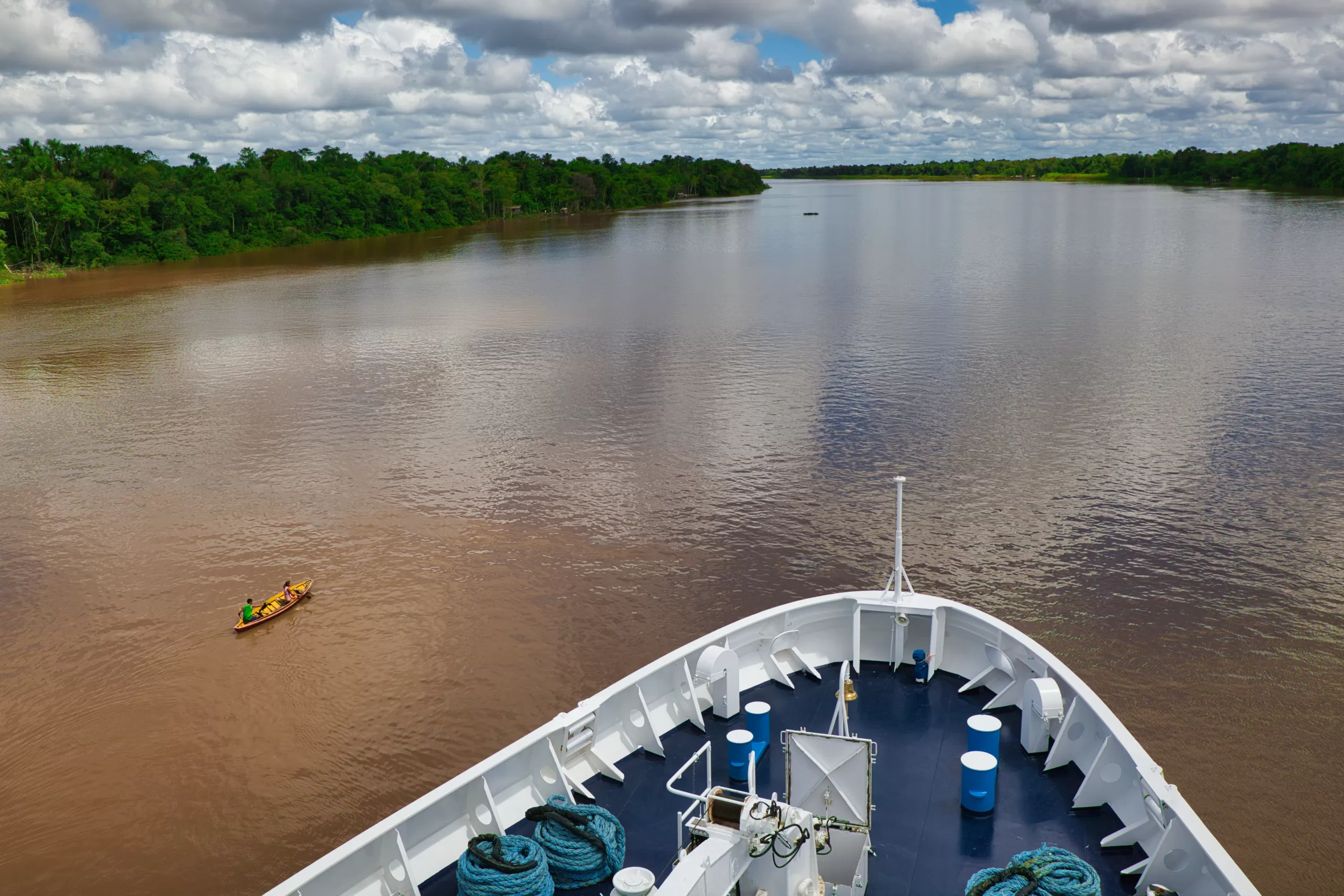
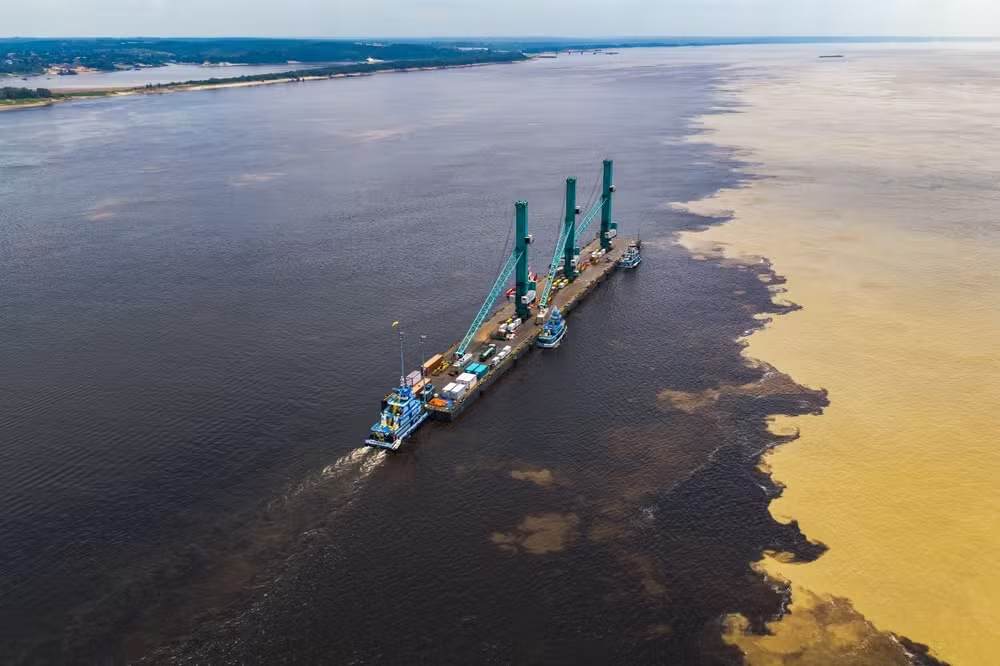
The exceptional volumes of the 2025/26 and 2026/27 seasons are placing significant demands on national port and transport infrastructure. While traditional southern ports such as Santos and Paranaguá continue to handle the lion’s share of exports, the Northern Arc trade corridor has become a vital route for moving grains from the Midwest and Northern frontiers, particularly during the Amazon wet season in the first half of the year.
Logistical integration has significantly improved with the development of the North-South Railway (EF-151), primarily benefiting the ports of Itaqui and Santos, as well as expanded river barge networks in the northern ports. Despite occasional operational hurdles, such as an indigenous occupation at a major soya bean facility in Santarém early this year, the Northern Arc – including terminals in Itacoatiara and the recently opened Novo Remanso terminal upriver on the Amazon – has stabilised. These routes reduce distances and facilitate backhauling, enabling lorries and river barges to carry fertilisers back to inland farms, thereby sustainably lowering overall production and transport costs within the Amazon river system.
The regulatory landscape underwent a major shift last July with the release of the Brazil-China Sustainable Soya Bean Supply Chain Guide. Developed by the China Chamber of Commerce of Import and Export of Foodstuffs, Native Produce and Animal By-Products (CFNA) alongside the World Resources Institute (WRI), the guide represents a significant milestone for Brazilian oilseed producers. Chinese buyers have dropped plans to impose stricter, zero-deforestation controls modelled on the private and rigorous Soya Bean Moratorium. Instead, they now officially recognise Brazil’s domestic environmental legislation – notably the stringent Forest Code (Federal Law 12,651/2012, as amended)– as the sole benchmark for compliance. Backed by the Mato Grosso State Soya Bean and Maize Producers Association (Aprosoja MT), the framework relies exclusively on statutory mechanisms such as the Rural Environmental Registry (CAR) for compliance verification.
On the domestic regulatory front, though progressing slowly, discussions between MAPA and agricultural stakeholders regarding proposed updates to official Brazilian soya bean grading standards are ongoing. Proposals to lower the maximum permitted moisture content (MC) from the current 14% to 13% have met resistance from farmers who are concerned over mass loss and short-term equipment costs. Nevertheless, aligning with international standards remains a governmental priority to maintain long-term competitiveness in Asian and European markets.
As long as the maximum allowable MC remains at 14% in accordance with standard sales contracts drafted by the National Association of Grain Exporters (ANEC), shipowners will continue to face heightened commercial exposure during long-haul voyages, particularly those to Asia.
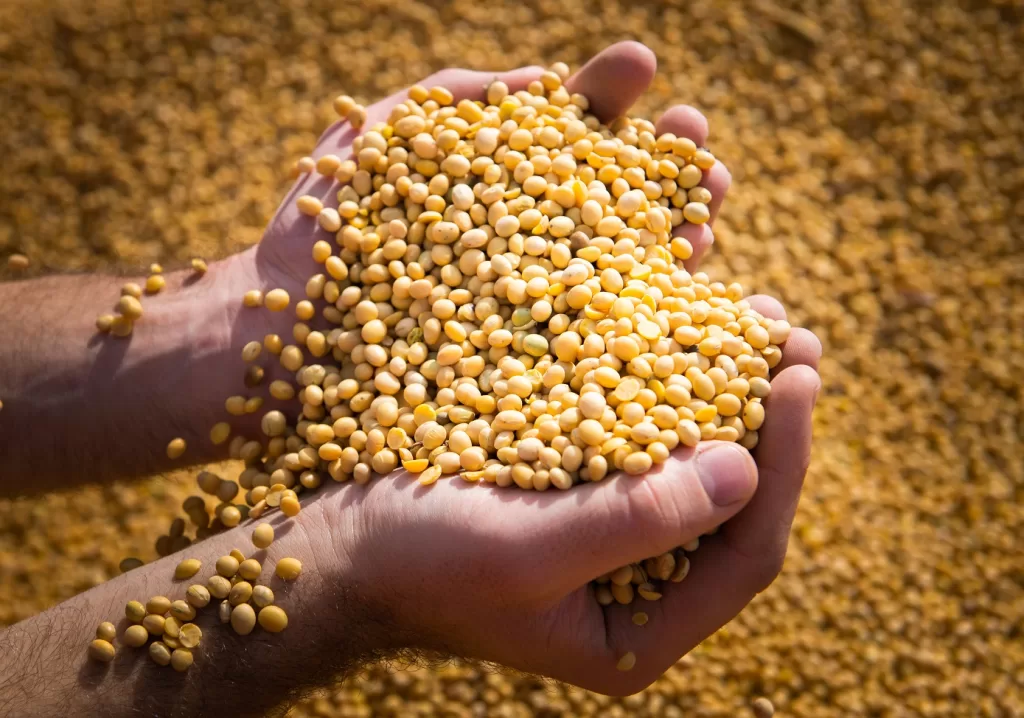
High inherent moisture frequently triggers microbiological degradation and self-heating, particularly when alongside a high cargo temperature, leading to potentially costly cargo damage claims upon discharge. To mitigate these risks, shipowners and masters are advised to enforce strict loss-prevention measures:
As the 2025/26 marketing year draws to a close with exceptional export revenues, the market anticipates a substantially larger harvest in the forthcoming 2026/27 season, bolstered by improved logistics and updated phytosanitary agreements with major buyers. However, despite the optimistic outlook, achieving projected records will largely hinge on mitigating the impact of the upcoming Super El Niño, which threatens to disrupt the growing cycle, reduce field yields, and cause significant restrictions in transporting the commodity from Amazon ports as they brace for harsh drought conditions from September through the end of the year.
Please read our Disclaimer
Related Topics:
Rua Itororó, 3 - 3rd floor
11010-071 - Santos, SP - Brazil
Telephone +55 13 4009 9550
proinde@proinde.com.br
Rua Barão de Cotegipe, 443 - Sala 610 - 96200-290 - Rio Grande/RS - Brazil
Telephone +55 53 3233 1500
proinde.riogrande@proinde.com.br
Av. Rio Branco, 45 - sala 2402
20090-003 - Rio de Janeiro, RJ - Brazil
Telephone +55 21 2253 6145
proinde.rio@proinde.com.br
Rua Professor Elpidio Pimentel, 320 sala 401 - 29065-060 – Vitoria, ES – Brazil
Telephone: +55 27 3337 1178
proinde.vitoria@proinde.com.br
Rua Miguel Calmon, 19 - sala 702 - 40015-010 – Salvador, BA – Brazil
Telephone: +55 71 3242 3384
proinde.salvador@proinde.com.br
Av. Visconde de Jequitinhonha, 209 - sala 402 - 51021-190 - Recife, PE - Brazil
Telephone +55 81 3328 6414
proinde.recife@proinde.com.br
Rua Osvaldo Cruz, 01, Sala 1408
60125-150 – Fortaleza-CE – Brazil
Telephone +55 85 3099 4068
proinde.fortaleza@proinde.com.br
Rua dos Azulões, Sala 111 - Edifício Office Tower - 65075-060 - São Luis, MA - Brazil
Telephone +55 98 99101-2939
proinde.belem@proinde.com.br
Tv. Joaquim Furtado, Quadra 314, Lote 01, Sala 206 - 68447-000 – Barcarena, PA – Brazil
Telephone +55 91 99393 4252
proinde.belem@proinde.com.br
Av. Dr. Theomario Pinto da Costa, 811 - sala 204 - 69050-055 - Manaus, AM - Brazil
Telephone +55 92 3307-0653
proinde.manaus@proinde.com.br